


THE COLDEST PLACE IN THE UNIVERSE
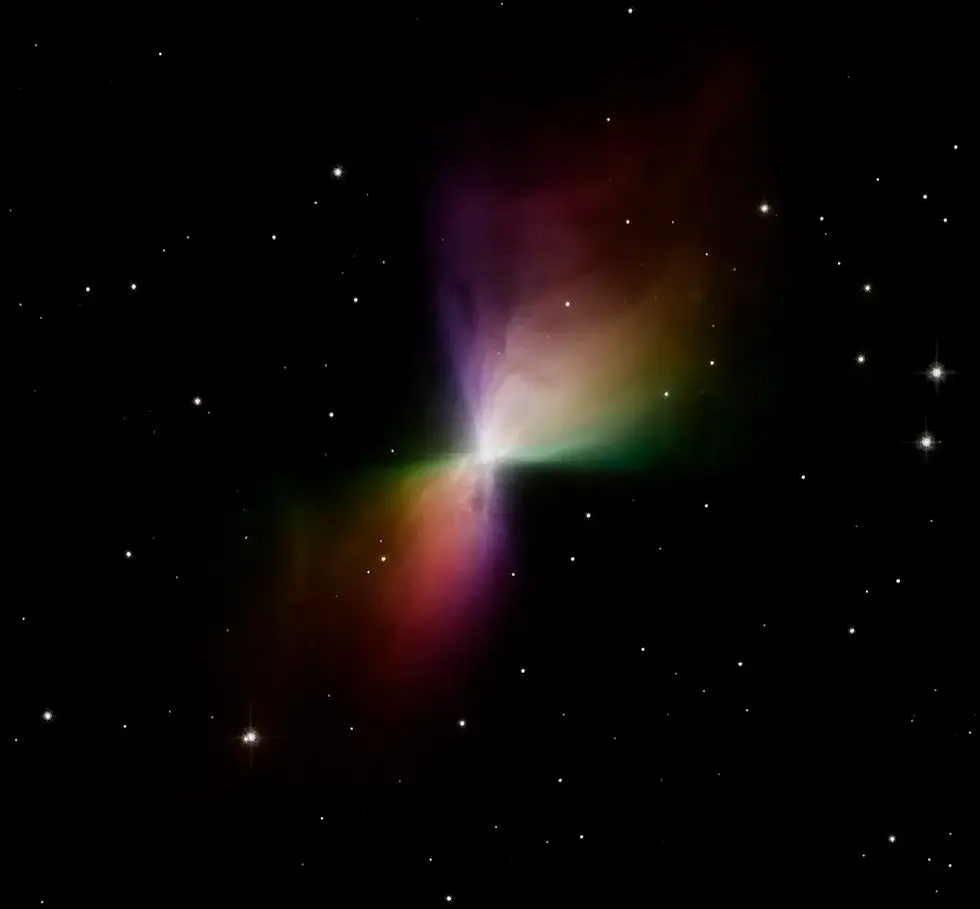
The Boomerang Nebula is the coldest known natural place in the universe, with a temperature of -272.15°C (-457.87°F), which is just one degree Celsius above absolute
When we think of the vast, dark expanse of outer space, we naturally imagine bone-chilling cold. And while space itself lacks a temperature in the traditional sense, the matter floating within it certainly has one. Left to its own devices, any object floating in the deep interstellar void will eventually cool down to match the ambient temperature of the universe. This baseline temperature is dictated by the Cosmic Microwave Background (CMB)—the fading afterglow of the Big Bang itself—which sits at a frigid 2.7 Kelvin, or about -270.45 degrees Celsius (-454.81 degrees Fahrenheit).
However, nature has a way of breaking its own rules. Located roughly 5,000 light-years away from Earth in the constellation of Centaurus, there is a mesmerizing cosmic cloud known as the Boomerang Nebula. Staggeringly, this nebula is colder than the empty space surrounding it. With a temperature plunging to just 1 Kelvin (-272.15 degrees Celsius or -457.87 degrees Fahrenheit), it is exactly one degree above absolute zero. This makes the Boomerang Nebula the coldest known natural place in the entire universe.
But how is it possible for a localized region of space to become colder than the primordial background radiation? The answer lies in the dramatic and violent final stages of a dying star's life, combined with a fundamental principle of thermodynamics.
At the heart of the Boomerang Nebula is a dying red giant star. As stars like our Sun reach the end of their nuclear fuel, they swell up and eventually shed their outer layers into space, creating what astronomers call a planetary nebula. In the case of the Boomerang Nebula, this stellar shedding process is happening at an incredibly rapid and forceful pace. For the last 1,500 years, the central star has been ejecting its mass at an astonishing speed of 164 kilometers per second (about 102 miles per second). Furthermore, it is losing mass at a rate of about one-thousandth of a solar mass every year, which is 10 to 100 times faster than other similar dying stars.
This is where the physics of adiabatic expansion comes into play. If you have ever used a can of compressed air to clean your computer keyboard, you may have noticed that the can becomes freezing cold in your hand as you spray it. This happens because the gas inside the can is under high pressure, and as it escapes into the lower-pressure environment of the room, it expands rapidly. When a gas expands rapidly without any heat being added to the system, it must expend internal energy to do the work of expanding. As a result, its temperature drops dramatically.
The exact same thermodynamic principle is operating on a staggering cosmic scale in the Boomerang Nebula. The ultra-fast outflow of gas from the dying star is expanding so rapidly into the near-vacuum of interstellar space that it cools itself down to a fraction of a degree above absolute zero. It is essentially the largest and most powerful natural refrigerator ever discovered.
Our understanding of this freezing cosmic ghost has been significantly refined over the years thanks to advanced astronomical instruments. When the Hubble Space Telescope first captured the nebula in 1998, it appeared to have a distinctive asymmetrical, boomerang-like shape—hence the name. However, more recent observations by the Atacama Large Millimeter/submillimeter Array (ALMA) in Chile have pierced through the dense dust clouds, revealing its true structure. ALMA showed that the nebula is actually a broader, rapidly expanding spherical outflow. The boomerang shape seen by Hubble was an optical illusion caused by a thick band of dust blocking the central star's light, allowing only two lobes of light to reflect off the expanding gas.
In addition to its icy nature, the Boomerang Nebula gives us a sneak peek into the future of our own solar system. In a few billion years, our Sun will also become a red giant and eventually shed its outer layers to form a planetary nebula. While it may not create a cosmic refrigerator quite as extreme as the Boomerang, it will undergo a similarly beautiful and violent transformation.
Ultimately, the Boomerang Nebula stands as a testament to the dynamic and surprising nature of our universe. It challenges our intuitions about the cold, dead vacuum of space, proving that the most extreme phenomena often arise from the fundamental laws of physics interacting on a grand scale. The next time you look up at the night sky, remember that somewhere out there, a dying star is actively refrigerating its corner of the galaxy, creating a spectacular, frosty monument to its own demise.


Comments